Sunday, April 10, 2011

28 - Treasury Operations in Islamic Banks

Treasury department play an important role in managing the bank’s funds. Two (2) important funds that the Treasury department normally manage are (a) the shareholders’ funds, and (b) the depositors’ deposits such as current account deposits, saving account deposits, general or unrestricted (special) investment deposits and specific or restricted investment deposit, Wakalah deposits and Commodity Murabahah deposits. Excess funds not use for financing activities purposes will be re-invested by the Treasury department in various Shariah compliant instruments that can yield additional income to the Bank.


What are the functions of Treasury Department?

In banking, two very important requirements that the Treasury Department must observes is the maintenance of the minimum statutory reserve imposed by Central Bank (Bank Negara Malaysia) and the Bank’s liquidity requirements. If the Bank failed to observe the above requirements (especially statutory reserve), it will be reprimand and fine by the Central Bank.

Other equally important functions of the Treasury Department is monitoring and controlling risks relating to overall short and long term return to the Bank thus it is important that the Treasury Department able to advise on the type of deposits that the Bank should market and the type of financing assets (including type of pricing) that the Bank should focus to avoid unexpected impact to the Bank’s income especially when Islamic banks are operating in business environment where 80% of the banking assets comprised conventional assets where “interest rate” play very important tools in determining the country monetary policy. In Malaysia, particularly since most of the Islamic banks’ assets (more than 80%) are fixed profit rate, the Islamic banks shall be exposed to commercial displacement risk due to movements of deposits from Islamic banks to the conventional banks or vice versa. Somehow, in Malaysia, most of the public and corporations are still indifference when it comes to “riba” investment instruments. To maximize return, depositors will move their money from one bank to another or move from conventional to Islamic system and vice versa. To reduce the impact of commercial displacement risk, maintenance of profit equalisation reserve was allowed in Islamic banks. Why this is allowed has been explained under Topic 27 on Profit Equalisation Reserve.

The actual level of involvement of a treasury department in profit rate risk management varies by institution, but generally speaking, the department would forecast net profit income and measure the sensitivity of the potential income to changes in profit rates and particularly, which we cannot deny, using conventional interest rate as benchmark. Typically the department would employ a variety of standard and proprietary models to measure this risk.

Result from their analysis will be reported to ALCO (Asset & Liability Management Committee) responsible for overseeing a variety of asset and liability (ALM) activities including the establishment of guidelines for the bank's risk tolerance levels.

The treasury department may further be tasked with ensuring risk management is within the guidelines set by ALCO by entering into a variety of financial transactions, such as profit rate swaps and so on.

Note: It should be noted that there are Shariah issues relating to profit rate swaps (one of our topics for discussion later) but as the Writer mentioned earlier, we shall discuss all the various Islamic banking products first and perhaps later once all the topics have been discussed, then only we shall revisit the Shariah issues (inclusive international arguments) and hopefully, we can derive one standard features which are acceptable by all Shariah Committee in the world. Probably by then, we may move away from certain products that are not acceptable internationally.

Internally within the various divisions in the banks, when each Division or Department is measured as whether it is a cost or profit centre, the Treasury also handles funds transfer pricing (FTP). At a high-level, the FTP process centrally manages the funding requirements of the entire bank in lieu of having each division fund its own balance sheet.

How effective is the Treasury Department would depend a lot on the Treasury Management System. If the Bank is operating under a window or Islamic subsidiary, the treasury management system need to support both the Conventional and Islamic treasury but importantly the transactions are not comingled (this might be one of the many reasons why Qatar Central Bank instructed conventional banks operating window operations to close down or sell-off their Islamic banking businesses) to ensure its meets strict Shariah requirement. The system should provide straight through, end-to-end processing, parameter-driven system to allow users to configure any money market, capital market and foreign exchange products that are currently traded in the marketplace.

The Treasury Management System should have the following modules:

  1. The Front Office applications should have suitable tools for managing the trading desk activities. Treasury dealers can monitor daily the trading activities from their respective deal blotter. Generally, the system provides real time information on dealer positions, currency exchange positions, and nostro positions as well as their daily profitability. Other tools that would help the Treasury dealers in analysing their position is that the system should have online calculators, a real time mark-to-market revaluations and the ability to provide "what-if" simulations on profit and exchange rate sensitivities enable dealers to better monitor and control their positions.
  2. The Middle Office module also provides real time compliances on the bank's credit, market and liquidity risks. During deal capture, positions and exposures created are validated and checked against the limits parameters set. Limits exceeded will be highlighted instantly and override commands are required to approve such breaches.
  3. The Back Office module performs all back office related functions of the Treasury department ranging from deal confirmation, settlement, deal maintenance and cancellation. Outward confirmations through various media such as SWIFT, Fax, Telex and e-mail are generated upon confirmation of the deal. Payment messages through SWIFT, direct debit/ credit and payment advices can be generated as well.
    (Source on treasury management system: www.silverlakegroup.com/2nd/solution5.html)

Asset Liability management (ALM) is a strategic management tool to manage profit rate risk, credit risk and liquidity risk faced by the banks. Banks manage the risks of asset liability mismatch by matching the assets and liabilities according to the maturity pattern or by matching the duration, or by hedging and securitization.

The activities related to sales and trading encompass dealing in money markets (to generate and invest liquidity) and in other controversial activities such as foreign exchange markets (to trade in currency) and derivative markets (to hedge). The later two activities are still subject to arguments by Shariah’ scholars but let’s not argue on these issues first but to understand how these activities are been offered and practised in Malaysia.


Islamicbankingway.Com
ALLAH KNOWS BEST

Tuesday, January 18, 2011

27 - Profit Equalisation Reserves (PER)

Profit Equalization Reserve (PER) was allowed to be used by Islamic banks probably about 11 years ago. It was approved by BNM National Shariah Council (NSC) with recommendation by AIBIM to mitigate deposit profit / interest rate disparities between the Islamic banks / window operators and Conventional banks.

For the last 17 years (especially within the first 5 years after 1997 financial crisis) of banking history in Malaysia, we have seen movement of deposits from Islamic banks to conventional banks and vice versa. For those who truly believe that usury (“riba”) is "haram" (prohibited) in Islam, they would continued to place their deposits in Islamic banks irrespective whether the deposit rates offered by conventional banks; but for others (particularly non-Muslims), its natural for them to place their deposits in banks that offer highest deposit rates to maximize return. Thus, for an investor who have no concern whether the banking system is "halal" or "non-halal", when a Islamic bank offers higher deposit rate than the conventional banks, he will move his deposits to the Islamic bank. On the other hand, when a conventional bank offers higher deposit interest rates, he will move out his deposits from the said Islamic bank. Of course, we cannot deny that there are investors who are contented with a bank due to its services thus, irrespective the deposit rate offered in the market, they remained loyal to their existing banks.

Looking at above scenario, for a conventional banks with Islamic subsidiary or Islamic window operation, it does not make sense to pay higher return in one system at the expense of another within its own group. As a result, AIBIM proposed PER (if I could recalled sometime year 2000 or perhaps earlier) which was subsequently approved by BNM-NSC. If the Writer remembered a comment was made when PER was approved (let's not worry by who) proposing that PER should be discontinued once the total Islamic banking assets reach about 40-50% of the total conventional banking assets to ensure  level playing field for both systems.

How is PER calculated?

The Writer is not sure whether there is recent revision in the PER Guideline (issued by BNM) but based on the Writer's best knowledge on subject matter, PER can be utilized and recouped under the following conditions:

#1 Maximum accumulation of  PER is not exceeding 30% of shareholders' funds;

#2 Maximum monthly transfer is not exceeding 15% of gross profits before distribution during the month. Thus, in a particular month when there is a large recovery, profit rates may be higher than usual.

#3 Unlimited utilisation to support profit rates due to low income for the month;  probably due to high general provision, additional specific provision or  to match conventional rate due to sudden hike in overnight policy rate (OPR) which directly affects the conventional base lending rate etc.

As mentioned under Topic (Chart 3 and 4), for transparency reasons, depositors’ consent should be obtained (the Writer is not sure whether Shariah Advisors have consensus on this issue) for the use of PER (please read Topic 21 to understand this requirement). The Writer is also not sure how many Islamic banks are strictly adopting this requirement.

IMPACT – Transfer of profits to PER

When extra profits (supposed to be shared between the bank and customers) are transferred to PER i.e. basically to avoid paying high profit rates (or to reduce cost of MGIA deposits)  so as not to be higher than conventional bank, the impact to the Islamic Bank would be as follows:

#1 PBT for the month will be reduced;

#2  “R” rate (benchmark for IIMM) will also be reduced. This means, Islamic banks that placed money with another bank under IIMM, will be paid lower IIMM profit rate than the indicative rate at the time of placement.

Example:

Bank X placed funds in an Islamic bank at indicative rate (to determine the PSR) of 3.5% p.a. Assume the “r” rate on placement was 6.40% p.a. but on maturity (assume today), the “r” rate is reduced to 6.25% p.a (reduction by 0.15% p.a.).

On placement, the profit sharing ratio ( PSR) was (3.5 /6.40 ) = 54.68 : 45.32 (Bank X : IIMM bank); but on maturity, Bank X will be paid at (6.25 x 54.68%) = 3.42% p.a. (lower by 0.08%). Result , is (+) positive carry to the Bank X.

IMPACT – Utilization of PER

When we choose NOT to increase the PSR but utilize PER to support profit rates to match conventional interest rates, impact to the Bank shall be as follows:-

#1 PBT for the month will increase;

#2 “R” rate (benchmark for IIMM) will also increase. This means, IIMM banks that placed money with Bank X will be paid higher than the indicative rate when placement was originally made.

Example:

Bank Y placed funds in Bank X at indicative rate of 3.5% p.a. Assume the "r" rate on placement was 6.40% p.a. but on maturity, the “r” rate increased to 6.65% p.a.  Original PSR on placement was (3.5 / 6.40%) = 54.68: 45.32 (Bank Y: Bank X) but on maturity, Bank Y will be paid (6.65 x 54.68%) = 3.63% p.a. (higher by 0.13%). Result is (-) negative carry to the Bank X.

IMPACT – Payment of “Hibah” (Gift) to MGIA depositors

Payment of “hibah” (this amount is paid from bank’s portion of the profits i.e. profit after distribution)  may be necessary, to avoid overall higher cost to the Bank or to support certain deposit tenor profit rates or in situation where there is no PER balance available. Impact to the bank shall be as follows:-

#1 Higher cost to the bank, due to:

a) When the bank's Treasury department carry too much IIMM placements (or "borrowings" in conventional terminology), cost to the bank MAY be higher if we are to utilize PER because utilization of PER will increase “r” rate thus indirectly we are paying more profits to IIMM banks.

b) Due to the use of fixed weightage (or WAR Method) for profit distribution instead of variable PSR for each deposit tenor, the profits to all placement/deposit tenors shall also be equally distributed. This means, longer deposit tenor will be proportionately distributed with higher return. In this situation, its not surprising for an MGIA 60-month deposit tenor profit rate is higher by more than 1.0% compared to a similar tenor for conventional bank (this issue has been discussed in earlier topics on profit distribution table)

c) Depending on the Islamic bank's strategy, it may pay slightly higher profit rate for certain deposit tenor instead of distributing equally as in (b). Under this strategy, "hibah" will be paid to increase the profit rate for certain placement tenor just to match conventional FD rate for similar tenor. This situation normally occur when banks are expecting certain hike in OPR thus, it would increase the deposit rate for say, 6 months deposit tenor so when the OPR actually moves-up, they already locked in certain targeted deposit volume at interest rate which is usually lower when the OPR hiked.

I think the above topic concluded our session on profit distribution. In our next session, which shall talk about the various  instruments used by Treasury Department in an Islamic bank, particularly in relation to Islamic Interbank Money market (IIMM) transactions.


IslamicBankingWay.Com
ALLAH KNOWS BEST.

Monday, December 27, 2010

26 - Profit Payment Method

We have to admit that most of current procedures relating to Islamic banking, including profit distribution methods that we discussed in last few topics were designed by those who started Bank Islam Malaysia Berhad. We should thank the staff and management of Bank Islam for pioneering Islamic banking in Malaysia. When BNM allowed the establishment of dual banking system (commonly known as "Islamic Windows") and subsequently other Islamic banks (including Islamic subsidiaries) all these methods are being adopted and most are still in use although some had undergone a number of revisions by BNM.

Due to above reasons, the Writer decided to also write about the old methods so readers of this blog will be able to know how the operations of Islamic bank in Malaysia evolves.

Before we close the topic on Profits Distribution Method, we need to also know the two (2) types of "Profit Payment Methods" as follows:-

1. Maturity method

  • Under maturity method, the applicable profit rate for the a particular deposit tenor (irrespective the number of months) is the final rate determined on maturity.  For example, let's assume the final profit rate for a 6-month tenor MGIA is  4.50% per annum. The said profit rate shall be applicable from month 1 to month 6.  What it means here is that "single profit rate" applicable for the whole six months;
  • Now, assume the same MGIA is renewed for another 6 months. On next maturity date i.e. 6 months later, the maturity profit rate is only 4.0% per annum. Likewise, the applicable profit rate for the whole 6 months period is only 4.0% per annum (a reduction by 0.50% per annum from previous placement)
2. Actual method

  • On the otherhand, under Actual Method, the profit rate varies from month to month. For example, the profit rates applicable for a 6-month tenor MGIA will be six (6) different profit rates based on "actual" percentage declared each month as per example in Chart 1.
      Chart 1


Note:  Some Islamic banks are using "moving average ratio" before declaring the profit rates to avoid erratic movement of profit rates. Examples of moving average rate charts are as follows:

Chart 2


"Moving average rate" formula is popularly used about 10 years ago but it is not surprising some Islamic banks may still use this to cushion the profit rates. Calculation for Chart 2 is as follows:

Chart 3


The advantage in using the "moving average profit rate" is that if the profit rate suddently hike due to say, large collection during the month, the profit rate can be reduced to avoid too much margin differences between the previous month's profit rates. Whatever the differences between the actual profit rate and the reduced profit rate due to "moving average rate" formula, will be transferred back to the general profit pool. Excess profit CANNOT be treated as extra income to the Bank.


One very important disadvantage in using this "moving average profit rate" is that during reducing profit rate trend instead of paying lower profit rate, the bank will be paying higher profit rate as per example in Chart 4 below:

Chart 4


Based on Chart 4, although the actual profit rate, say on month 13th is 4.30% per annum, due to the moving average formula, the Islamic bank will be paying 4.58% per annum. The bank will pay-out 0.28 percent more than what it should declare. As a result, the additional profits need to be deducted from "Profit Equalisation Reserve" to pay the extra amount.

The Writer opines that 'moving average profit rate" formula should not be used as it's like taking away what is due to the depositors during rising profit rate trend and it will have adverse effect on the bank on reducing profit rate trend. The best option is to declare actual profit rate.

Now, let's make comparison between the Maturity and Actual Method as follows:

Chart 5


Note: Zoom your view to higher level - 150% to read this Chart.

In next topic we shall discuss a bit more on the "Profit Equalisation Reserve" (PER). Why banks are allowed to create this account?


IslamicBankingWay.Com
ALLAH KNOWS BEST


:

Friday, November 26, 2010

25 - Profit Distribution Table

In our previous sessions, we have discussed the concept of profit sharing, how profits are recognised as income by the bank and how profits are distributed. The Writer shall now reveal the step-by-step profit calculation method using Microsoft Excel table (commonly referred to as "Profit Distribution Table) with Table/Chart examples,  with the hope that ALL existing and potential users of Islamic banking system will be able to visualise how profits are actually distributed by Islamic banks.

It should be noted that the guidelines in calculating profits for distribution are stipulated in the Profit Distribution Framework issued by BNM (some of the terminologies used by the Writer may not be same as the framework) to ensure industry standard and one of the main items that BNM auditors normally audit in Islamic banks is Profit Distribution Table (PDT) records.

In most Islamic banks, the profit distribution table are prepared manually using Microsoft EXCEL but there are probably about three (3) Islamic banks (maybe) that have automated this process. The Writer opines that the PDT should be one of the items that Shariah Department and Bank's Internal Auditors should audit, since this process is still mostly done on manual basis thus open to possible calculation errors.

In Malaysia, there are two (2) profit distribution methods, namely;

 (1) Weightage-Average-Ratio (WAR) Method, and

(2) Profit-Sharing-Ratio (PSR) Method .

The Writer wish to reiterate that this subject is very technical but the Writer will try to explain in the simplest way possible. Let us start this session with the WAR Method.

1. Weightage-Average-Ratio Method (WAR)

Under this method, the Bank will use various ratios known as the Weighted Average Ratio (WAR) for each deposit placement tenor (e.g. 3, 6, 9 months and so on) to represent the importance of one deposit tenor in comparison with another. For example, 12-month tenor deposit is considered more stable for the operation of an Islamic bank when compared to a 1-month tenor deposit. If a Customer places deposit for 1-month tenor, operationally the bank needs to monitor the deposit movement closely (especially for large deposits) as it does not have assurance that the 1-month tenor deposit will remain with the bank on maturity compared to a 12-month deposit tenor. Although depositor can still uplift the 12-month deposit prematurely, at least the bank does not have to worry about it for the next 11 months. Thus, to ensure fairness in term of profit distribution, depositors who place funds under a longer tenor deposit shall be paid higher profits (as required by Shariah) compared to those who place deposits under a shorter tenor. To do this, higher  WAR will be assigned to a longer tenor deposits. Under WAR method, the profit sharing ratio (PSR) is fixed until maturity and if the bank decides to change the standard profit sharing ratio, it has to write to BNM with their justification (the Writer is not sure whether BNM has the rights to reject the request) and any changes on the PSR for existing accounts can only be affected on renewal. For automatic renewal accounts, consent must be obtained from the depositors.


Under conventional fixed deposits (FD), it is quite common where FD rates for longer tenor deposits are at times lower than the shorter tenor or vise verse depending on the deposit taking strategy of the bank thus, comparatively its more flexible compared to the Islamic bank WAR method. But if we are to look at it positively, conventional banks do not subscribe to the principle of fairness as compared to Islamic banks.

However, in practise there are still Islamic banks (perhaps 1 or 2 in Malaysia) that are not really following the principle of fairness mentioned earlier as the Writer observes that there are times when lower profit rates are declared for longer tenor deposit compared to shorter tenor. Perhaps, the bank is using the PSR Method where different profit sharing ratio is assigned for different deposit tenor. As for the PSR Method, most Shariah scholars are of the opinion that the principle of fairness does not apply since customer is aware of the profit sharing ratio for each type of deposit tenor before placing the funds i.e. element of offer and acceptance is presence prior placement of deposits. We shall discuss about the second method in details once we have examined the WAR Method.

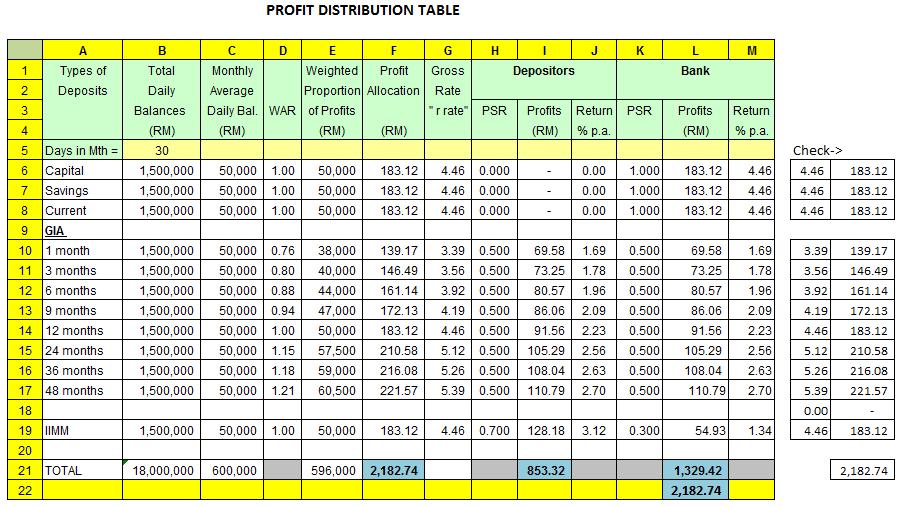
Now, let's see how profits is calculated using WAR method. At a glance, detailed view of the Profit Distribution Table is as per Chart 1 below.

Chart 1


Note: You can use zoom level of 150% to view Chart 1 clearly. The purpose of each columns will be clarified in next few charts as follows:-

Chart 2


Chart 2 can be explained as follows:

# Column A  is the description of the various types of deposits (including other liability items) that are eligible to be included the PDT.

# Column B is the total daily balance comprising sum of daily balances for the whole month e.g. On Feb-1, the day-end balance is RM 50,000 while on Feb-2 the day-end balance is RM45,000. Thus, total daily balance for the first two (2) days is RM95,000. (Take note that to simplify our example, we are using RM50,000 as the daily day-end balance throughout the month). So, to get the total daily balances, system will accumulate the daily balances up to month-end. The month end total sum result will then be divided by the number of days in the month (for our example, we are using 30 days in the month) and that will give us the Monthly Average Daily Balances (MADB).

To understand the calculation, let's examine Chart 3 below:-

Chart 3


All the RM50,000 as shown in Column C of Chart 3 above, is the MADB for the respective tenor deposits. [Calculation for Line 10 Column A  - RM1,500,000 divide by 30 or number of days in the month = RM50,000].

Now, how Weighted Average Ratio works? Let's examine Chart 4 below:-

Chart 4


# As earlier mentioned, the Weightage Average Ratio in Column D of Chart 4, is the ratio assigns  to a particular deposit tenor to determine the importance of a particular deposit tenor compared to another. Under Column D, you will see that the WAR for 1-month tenor deposit is 0.76 while the WAR for 48-month tenor deposit is 1.21 and so on,  as recommend in the BNM Profit Distribution Framework. As earlier mentioned, the WARs can be changed but the Islamic bank is required to inform BNM with their justification for changing the same.


# Thereafter, the AMDB of RM50,000 times the WAR of 0.76 will give us the Weighted Proportion of Profits (WPP) of RM38,800. What it means here is that although the original deposit amount is RM50,000 but for profit distribution purposes, the deposit placed with the Bank is treated as though it is only RM38,000 for profit distribution purposes. Likewise, for 48-month tenor deposit of RM50,000 with WAR of 1.21, the Weighted Proportion of Profits is RM60,500 [RM50,000 x 1.21 = RM60,500]


Once, all the WPPs are obtained for all types of deposit tenors, profits can now be distributed. For our example, let's assume gross income from operations is RM2,182.74 (refer to Chart 5 below)

Chart 5


What is Chart 5 all about? Simple understanding of the chart - Capital funds + Deposits equal to total deposits of RM600,000 for bank's operations. From the total deposit,  we deduct statutory reserve (SR) , say 4% (RM24,000) and liquidity ratio, say 15% (RM86,000), that will gives us RM576,000 available for investment and financing activities.

We further assume bank's only financing account (without taking into BNM other requirements such as large financing, single customer limit etc.) is RM400,000. At financing profit rate of 7.50% per annum, monthly income to the bank is say, RM 2,465.75.

Whatever amount not used for financing purposes plus liquidity amount, totally RM176,000 will be placed in the Islamic Interbank Money Market (IIMM). At a IIMM average profit rate of 1.50% per annum, the bank earns RM216.99 for the month which gives us the amount of RM2,182,74 for profit distribution.

It should be noted that the gross profit to be distributed to bank and customer is after deducting allowed cost by BNM such as general provision, specific provision, commission and fees (as discussed earlier under Topic 23). Operating cost will be borne entirely by the Bank. Take note again that for above example, we assume GP is provided based on amortized basis i.e. full amount to be provided is divided equally over 12 months (max). In practise, whatever GP amount must be provided within the same year and some banks, provide GP based on their projected financing balances to avoid large provision amount that may impact their monthly profits. We shall discuss more on GP in later Islamic Accounting session.

Our next calculation is to get the gross profit before distribution. Before we go into details, let's take a look at Chart 6 below that shows the amount of profits to be distributed and how the same is converted into percentage as follows:-

Chart 6


The gross profit before distribution amount of RM2,182.74 will be placed in total column in the PDT (Line 19/Column F) and since we are using EXCEL formula, the profits will be automatically distributed upwards to the type of deposits and WPP amount assigned to it.

Now, let's see how profits are distributed. (refer to Chart 7 below):

Chart 7


To calculate the Profit Allocation amount, we take the WPP for 48-month deposit tenor of RM60,500 and divide the same with the total weighted proportion of profits (Line 19/Column E) amount of RM596,000 [ 60,500/ 596,000] times the gross profit amount of RM2,182.74, and that will give us RM221.57 [ (60,500/596,000) x 2,182.74 =221.57) ] profit allocation for 48-month tenor deposits. This means, although the placement amount for 48-month deposit tenor is RM50,000, since it is a long-tenor deposit with WAR of 1.21 and assigned-deposit amount of RM60,5000, profit sum of RM221.57 from the total RM2,182.74 is allocated.

So, before we show you further the steps to calculate the percentage, the Writer which to explain on why we MUST convert the amount distributed into a percentage instead of showing the absolute amount, say RM221.57.


Why we need to explain this..? Till today, there are still Muslims who said that the profits normally declared in "percentage form" is "riba" because it emulates the "interest-rate percentage" of conventional bank. The Writer wish to reiterate that for conventional bank, the end-result is actual rate represented by percentage (%) but for Islamic bank, the actual end-result is an absolute amount in figure. But to analyze and to compare the performance of each deposit types and also to compare Islamic bank's deposit performance against the conventional FD, we need to convert the end-result from absolute amount into percentage. Thereafter to convert the amount into percentage, we take the profit amount of RM221.57 divide by the original placement amount of RM50,000 x 100 (to convert to percentage) times [365 days in the year and then divide by 30 days in the month], that will give us a gross profit percentage of 5.39% as shown in Chart 7 above.


Take note that the gross or "R" rate ("R" actually means Reference or reference rate) for 12-month tenor  deposit  currently being by Islamic banks as the profit-sharing ratio negotiation benchmark for Islamic Interbank Money Market (IIMM). For this reason, the WAR for 12-month tenor is 1.0 (We will learn more on IIMM in later session)


Once we already obtained the gross profit before distribution for each deposit tenor, the next step is to distribute the profits according to the agreed profit sharing ratio. In Chart 8, the PSR is 50:50 (normally written as Depositors: Bank which means 50% for Depositors and 50% for Bank). The "R" rate for this example is 4.46 (Line 14 Column G).

How let's look at Chart 8 below.

Customers' profit is calculated by taking the gross profit amount of RM221.57, then times that amount with the profit-sharing ratio of 50% to give a return of RM110.79. To calculate the effective return in percentage to the Customer, we take the net amount distributed i.e. RM110.79 divide by the original amount (RM50,000) times 100 x 365 days and divide by number of days in the month, which is 30 in this example. That will give us a profit percentage of 2.70% per annum. Since PSR for the bank is also 50%, the bank shall also be allocated the amount of RM110.79 with profit percentage also at 2.70% per annum.

Chart 8


From Writer's own experience, it is important to explain to bank's management of Islamic subsidiary parent bank that the percentage 2.70% which is high (maybe compare to conventional FD rate of say, 2.5% prevailing at the time) does not mean that the bank is out-of-pocket in comparison with conventional FD at 2.50% per annum. Since the PSR is 50:50, when we pay depositor the rate of 2.70% per annum, the bank shall also be allocated with 2.70% per annum. Some people in the parent bank may misunderstood that Islamic bank is over-paying to their long-tenor depositors.


Now, how to know whether our calculation is correct? To counter-check, the total profits payable to depositors (RM 853.32) plus the total profits due to the Bank (RM1,329.42), will equal to the amount or gross profit before distribution i.e. RM2,182.74 as per Chart 8


THE ABOVE EXAMPLES ARE STEP-BY-STEP CALCULATION OF THE WEIGHTAGE AVERAGE METHOD but another method which is allowed by BNM is the Profit Sharing Ratio Method to be explained below.


2. Profit-Sharing-Ratio Method (PSR)

The Profit-Sharing Ratio Method is the simplest method of profit distribution. The Bank will assign different profit-sharing ratios for the various deposit tenors. For example, for the same 18-month tenor, the profit-sharing ratio offered may be, say 80:20 (Depositor: Bank) in favour of depositors while for 24-month deposit tenor, the profit-sharing ratio may be 85:15.

Before we go into details, lets look at the overall PDT under the PSR method as per Chart 9

Chart 9


Now, lets' go into details (refer to Chart 10)


Chart 10


Unlike the WAR Method, under PSR Method, we need to determine the deposit volume percentage. This means, profits will be distributed based on the volume of each deposit type. So, based on our example in Chart 10 above, the Monthly Average Daily Balance of RM50,000 is divided by Total Average Monthly Balance of RM600,000 (Line 21/Column C) to get the percentage of deposit volume, which is 8.33% [50,000 /600,000 x 100 = 8.33% ]


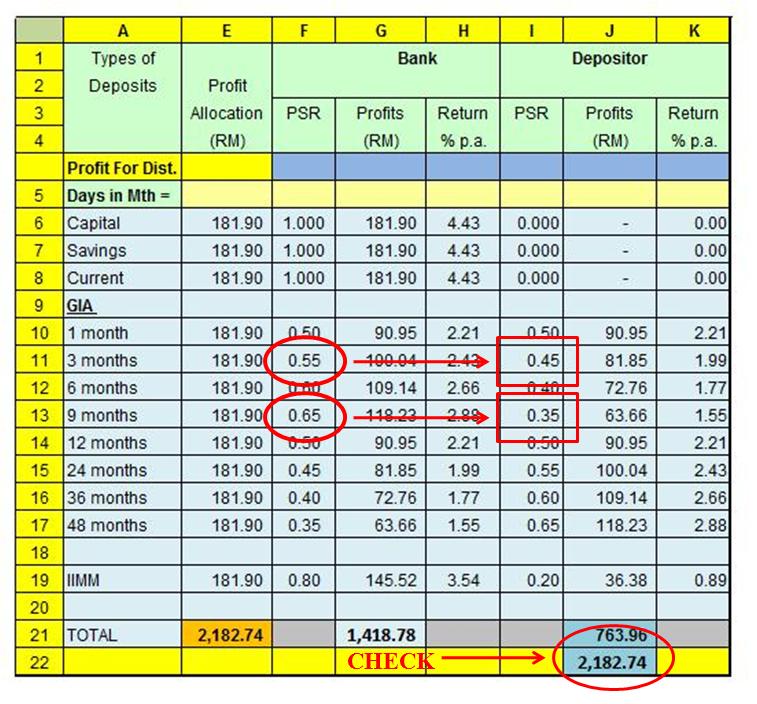
Once the deposit volume percentage is obtained, we take the gross profit amount of RM 2,182.74 times 8.33% and that will give profit allocation of RM181.90 [RM2,182.74 x 8.33% = RM181.90 ]

Once we obtained the profit allocation, the same can be distributed immediately according to the profit sharing ratio for each type of deposit as per Chart 11 below:

Chart 11


Under the PSR method, the profit-sharing-ratio for longer tenor deposits can be lower than the shorter tenor. Since prior placement, depositor is made known on the profit-sharing-ratio, once the deposit is placed, the profit sharing ratio remains until the deposit matures. One very important advantage in using this method is that Islamic banks can response quickly to market demand on deposits. Islamic bank can raise the PSR immediately for new, say 1-month deposit tenor, if it needed large funds to meet sudden huge withdrawals. The bank can also offer varies PSR for different tenor deposits (refer Chart 12)

Chart 12


To check whether the PDT is correct, add the total amount to be distributed to the Customer and the profits due to the bank. If the amount is equivalent to the gross profit before distribution, the PDT is correct.

In order for Islamic Bank to gain better share of the profits, Islamic Bank will have to manage its deposit by offering lower sharing ratio to depositors e.g. using Tier-2 profit sharing ratio which means, if a Corporate depositor placed RM1.0 million under standard profit sharing of say, 50:50, any other amount above the RM1.0 million, the Bank may accept further deposits but at say, 60:40 (Bank:Depositor). This situation normally occurs when the market is flush with deposits.

This conclude our session on profit distribution and in our next session, we shall discuss on some related issues related to the Profit Distribution Table such as:-

1. Payment of profits - comparison between actual and maturity method. Why Islamic banks should use actual method;

2. Profit Equalisation Reserves;


Thereafter, we shall discuss about types of treasury products, Islamic Interbank Money Market and financing products.

Before we end this session, as promised for those who are interested to do some exercise on profit distribution Table, you may email to the Writer at islamicbankway@gmail.com for profit distribution table exercise worksheet. In your request email, just let the Writer know your nature of business and your location (country)  for the Writer's internal survey purposes according to the following category:

Student (country)
Conventional banker (country)
Islamic banker (country)
Legal Practitioner (country)
Shariah Scholar (country)
Non of the above (country)


IslamicBankingWay.Com
ALLAH KNOWS BEST.

Monday, November 22, 2010

24 - Profit For Distribution

Before we deal in depth on the profit distribution table, let's look at two (2) examples on how profits are extracted for income recognition purposes prior distribution.

Let's take Account No. 1 (Chart 1) where income is calculated using Monthly Rest formula (or reducing balance method). Details of Account 1 are as follows:

# Financing period = 12 months
# Profit rate = 10.0% per annum
# Unearned income = RM550.40
# Sale price [ RM10,000  + RM550.40) ] = RM10,550.40
# Monthly installment = RM879.20
# Profit for Month-1 = RM83.81 [Formula RM10,000 x 10 divided by 1200 ]

Chart 1


Based on simple calculation as above, profit for the first month is RM83.81 (actual calculation using system, the calculation shall be principal balance x profit rate % x no. of days in the month divided by 365 days).


Account No. 2 (Chart 2) is based on Flat profit rate commonly used for hire purchase financing or Ijarah Thumma Al-Bai as offered in Malaysia. For flat rate financing, even though the pricing is quoted at 5.50% flat, effectively (when we convert to Monthly rest calculation) the rate is about 10.0% per annum.

Now, let's look details of Account 2:

# Financing period = 12 months
# Profit rate = 5.50 Flat per annum
# Unearned income = RM550.00. In chart noted as RM465.38 (RM550.00-84.62)
# Sale price [ RM10,000 + RM550.00) ] = RM10,550.00.
# Monthly installment = RM879.20
# Profit for Month-1 = RM84.62 [ profit higher by 0.81 compared to Chart 1]

From the examples, you will notice that the installments are the same but the profit due under Rule 78 formula, is higher i.e. RM84.62 compared to the profit calculated using Monthly Rest formula. This means, under Rule 78, the profit portion will exhaust faster compare to the normal monthly rest profit rate. In other words, when you take up financing using Rule 78 and decide to prepay the facility, it's worth settling the same early because towards maturity, more amount will be used to pay-off the principal portion.

Chart 2


From the above two (2) examples, the profits are extracted as follows:

Chart 3


Chart 3 is the simplest example on how profits are shared.  Profits from both Chart 1 & 2 when combined, will give us a gross profit amount of RM168.43. Based on straight forward profit sharing ratio of 70:30 [Customer: Bank], profits payable to the Customer is RM117.90 while the balance RM50.53 is payable to the Bank.

To calculate the effective profit rate, let's assume the bank's total deposit is RM20,000. Based on simple formula above, the profit rate that the Bank will declare is 7.07% p.a. but normally, bank will use effective rate by multiplying the same by 100 times 365 days over no. of days in the month.

In our next session, we shall discuss on more technical topic on profit distribution table i.e. how to use the Profit Distribution Table where various income are captured for distribution purposes.


IslamicBankingWay.Com
ALLAH KNOWS BEST.

23 - Income Recognition Method

How are profits recognized and earned?

When we talk about income recognition, we have to admit that Islamic banks do not have its own income recognition formula for debt financing facility. Except for Musharakah and perhaps Ijarah (considered as pure rental income) there is "no hadith" (perhaps Shariah scholars can help us on this issue) that distinguish the profit and principal portion meant for debt financing facility. Thus, Islamic bank today are actually adopting the conventional bank's formula for debt financing facility with strict modification that income cannot be earned on COMPOUNDED basis.

What do we meant by "on compounded basis?" My straight forward answer is that when recognising financing income, Islamic banks cannot adopt the "interest-upon-interest" method used by conventional banks. For example, when a conventional bank customer defaulted his installment this month, the unpaid interest amount will be added to the following month opening principal balance [ i.e. unpaid interest + principal outstanding = new month opening balance.]  Thus, interest for the following month is calculated over the new opening principal balance.

For Islamic banks, unpaid profit shall remain as "profit earned but not yet paid" and that amount CANNOT  become part of principal amount of the following month or the month after  irrespective whether the customer defaulted or the account is to be restructured or rescheduled.

The Writer had earlier mentioned there is no 'hadith" specifying the formula and how income is to be earned thus, the Writer opines that banks' Shariah Committees are  not worry about income "recognition formula" as long as the calculation method and the amount calculated are not deemed as ' interest ' when earned. Although there may be disagreement among the Shariah Scholars  as to whether certain Islamic products or structures are shariah compliant, to-date, Shariah Scholars tend not to get involved in the "formula arithmetic" in determining the profits. One important Shariah requirement when it comes to income recognition is that earning MUST be based on NON-COMPOUNDING basis and should never emulate the conventional method where compounding or "interest-upon-interest" method has been  in used since ages. Although from some information there are Islamic banks that earn "compounding income", we really hope that this is not the case. If you are an Islamic banker, why not do a quick check on how your bank earns their financing income for default cases?

Based on Writer's past banking experience, income for financing under lease, debt or profit sharing contract can be recognised using the undermentioned formulas :-

Note : Some of the formulas may no longer in use.

1. Payments to be treated as profit first (cash accounting)

Using straight line method as per example in Chart 1, for the first four (4)  years whatever installments received are to be treated as profits/ income to the bank while the principal amount is payable over the remaining financing tenor.

Before we show you the various charts on the income recognition methods, lets understand the table columns showed in the chart 1:

a) Month - the month installment due and income earned;

b) Monthly Installment - can only calculate this if we know the (i) financing amount (ii) financing tenure or financing period and (iii) profit rate which can be based on monthly rest, flat rate, daily rest or yearly rest depending on the type of structure.

c) Amortisation - the distribution of profit to be earned by the bank and gradual payment of principal amount, embedded together in the monthly installment;

d) Unearned profit - total profits due (for whole facility) to the bank and payable by the customer. The longer the financing period, the higher will be the unearned income. Unearned income plus principal will equal to sale price for debt financing. For conventional banking there is no sale price but the same can be determined by calculating the installment amount times financing period in no. of months.

e) Original Principal  - this equal to the original financing amount;

f) Balance Outstanding - comprise [ original principal + unearned income after net off the monthly installment.] Only when this figure is zerorised, the financing facility is considered paid in full. In debt financing facility, the balance outstanding is equal to the sale price outstanding amount.

Now let's look at Chart 1 again.

Chart 1


Workings

# Unearned Income  [ 10,000,000 x 8.25% x 10 years = 8,250,000 ]
# Installment [ 10,000,000 + 8,250,000 = 18,250,000 divide by 10 years = 1,825,000 ]

Is there a bank earning using the above formula? Yes..! but the Writer is not sure whether this bank still exits or still doing it. In 1996, the Writer attended an Islamic banking seminar in Istanbul, Turkey. One of the speakers in the said seminar reiterated that his family bank (Gulf based) earned income based on above method because it is privately owned bank (then) and does not depend on public deposits.

2. Amortize monthly using straight line method over deferred payment tenure

Under this method, amortization of profits and principal are divided equally over the payment periods (refer Chart 2) . In real situation, this type of formula is normally used for short term financing e.g. 3 to 6 months financing period.

Chart 2


Workings

# Unearned Income [ 6,000,000 x 8.25% x 0.5 months  = 247,500]
# Principal payment [ 6,000,000/ 6 months = 1,000,000 ]
# Profits [247,500 / 6 months =  41,250 ]
# Installment [1,000,000 + 41,250 = 1,041,250 ]

Since the principal balance is on reducing balance, while income amount is the same throughout the financing tenure, effective yield (due to same income but lower principal balance) become higher as the facility is about to mature e.g. 25% on the 6th month.

3. Amortize monthly using similar amortization formula  (a) Monthly Reducing Balance; or (b) Flat Profit Rate (Rule 78)

(a) Monthly Reducing Balance (MRB)

The most common earning formula used by existing Islamic banks is MRB formula (refer to Chart 3). Under this formula, income earning can be divided into two (2) types:-

(i) Pre-scheduled method - similar to calculation using Microsoft Office EXCEL programme. This formula is also known as Constant Rate of Return Formula.

 and

(ii) Reducing Method - profits are calculated based on outstanding principal balance on month-to-month basis.  


More detailed examples of the above will be discussed in our our later session on "Islamic Accounting"

Chart 3


For Excel table, you can use the following formula:

#Monthly Installment:  = PMT(PR/100)/12, Tx12, - P  where PR=Profit Rate, T=Tenure and P=Principal
# Sale Price = Monthly Installment x [ Tenure x 12 ]
# Unearned Income = Sale Price - Principal

or use the formula as follows:


(b) Flat Rate

The flat rate profit method (also known as Rule 78) is used for hire purchase (Ijarah Thumma Al-Bai) and lease financing (Ijarah or Ijarah Muntahiya Bitamlik). Example of Rule 78 is as per Chart 4.

Chart 4


The formula:


4. Joint-Venture Profit Sharing Method

Profit is calculated based on agreed profit sharing ratio (PSR) pre-determined prior entering the joint-venture contract. Profit/(or losses, if any) is normally determined on completion of project/maturity of financing term. If profits are paid in advance (normally at certain agreed percentage), the advances amount will be re-calculated once actual profit/(or losses) has been determined. Example of profit sharing ratio table is as per Chart 5 below.

Chart 5


5. Yearly Rest Method

Yearly rest method is used by most banks sometime late 1980s or early 1990s. This formula was later discontinued when the BNM (through the Association of Banks Malaysia) issued a new regulation to standardize the formula calculation for term loans etc. Based on Chart 6 below, the profit/(or interest since this is commonly used by conventional banks) it re-calculated every January 1st based on the outstanding principal balance on 31 December each year.

Chart 6


Normally for yearly rest calculation, the amount outstanding may take slightly longer period to be paid due to the way the profit (or interest) is calculated and also depending on the prevailing interest/(profit). Based on simulation as per Chart 7 below, the financing/loan only full paid on 10.4 years.

Chart 7


6. Daily rest method

Daily rest method is normally used for Cash Line (or overdraft) financing facility. Daily rest calculation is similar to the monthly rest method but the only different here is that profit is calculated on daily basis based on daily principal balance. Unlike conventional banking, the daily profits cannot be compounded. At month-end whatever daily profit accrued will be totalled up as income for the month.

Thus, based on the above examples, there are six (6) profit calculation methods (maybe there's more) but most commonly used by Islamic banks today are method 3, 4 and 6.

In our next session, we shall discuss about profit distribution using the reducing balance method.


IslamicBankingWay.Com
ALLAH KNOWS BEST.

Thursday, November 18, 2010

22 - Application of Funds

In next few sessions we shall be discussing on a very technical subject relating to how profits are shared between the Islamic banks and their depositors. For those who have been following my blog just to know about Islamic banking in general, go through the topics to have a surface understanding on subject matter but, for students planning to make Islamic banking as their future career and also to practising Islamic and conventional bankers with intention to move their career to Islamic banking,  my suggestion is for all of you to spend some time on my next few topics to appreciate how the profit sharing mechanics work. It is interesting to note that last two (2) years or so, there was a survey forwarded to all Islamic banks on a new or additional profit sharing method using "deposit bucket" but the same is yet to be implemented.  

Towards the end of this session (which shall be divided into several topics), the Writer will provide a blank Profit Distribution Table worksheet (excel form) with some questions. Those interested to understand this topic in depth,  suggest you complete the said exercise.

Before we discuss about the profit sharing methods, we must understand this simple application of funds comparison between conventional and Islamic bank. Let's examine:-

1. Conventional bank makes money from the interest charges on loan it lent out and the cost of deposits (to be more precise - cost of funds) it has to pay to fund the loan, apart from other auxiliary income such as fees and commission etc. On the otherhand;

2. Islamic bank makes money after it has paid its depositors’ portion of the profits based on agreed profit sharing ratio. Under this profit sharing principle, the depositors are the Bank’s joint venture partners ( also share the risk) thus whatever profits paid out by the bank to the depositors are technically, not an expense item (contrary to what is presented in Islamic bank P&L and Balance Sheet) but the depositors’ share of the overall profits distributed by the Bank (who acts as an entrepreneur) in running the business on behalf or jointly with the depositors i.e. depending on types of funds.

Before we discuss on the more technical part of this topic, lets evaluate the overall application of funds of a bank through this simple chart as follows:-

Chart 1 - Application of Funds (Islamic)


Looking at Chart 1, you will notice that sources of funds comprise mainly from three (3) deposit types namely, savings, current and general investment accounts. Although commodity murabahah is also used to garner counter deposits, it is more popularly used by Treasury Department to secure large deposits at fixed rate.

In Malaysia, savings and current deposits accounted to about 20-30% while MGIA is about 50-60% and commodity murabahah is about 10% or maybe lesser. After setting aside certain portion for statutory reserves (currently 1% set by BNM) and for liquidity purposes (normally ranging from 10-15% but in practise depending on how effective the Bank manages its liquidity), the difference is used for financing and investment activities for the bank to generate income. Whatever income derives from these activities are placed in a General Profit Pool (gross profit) prior distribution. After deducting general provisions or certain provisions as required under IFRS accounting, broker's fee, specific provision, income-in-suspense (most Islamic banks still maintain this treatment) and profit equalisation reserves (PER), the balance will be distributed according to the agreed profit sharing ratio between the bank and the depositors. It should be noted that service charges and commissions which are non-financing related are normally not shared with the depositors thus, it will be treated as full income to the Bank.


Excess funds like liquidity reserves and money not use for financing and investment activities, will be placed in the Islamic Interbank Money Market (IIMM) or for purchase of halal securities, sukuks etc

Likewise, for Specific Investment Account, similar treatment is done but whatever income generated from application of this funds shall be placed in a specific pool where whatever balance after deducting similar allowed expenses under Specific Investment contract, shall be distributed only with the Specific Investment Depositors.

Human resources (HR) costs, administration and other operating expenses are to be borne solely by the Bank thus whatever income distributed thereof to the Depositors is technically on gross basis. Under normal non-banking business activities e.g. Sdn Bhd company, the HR, Admin and other costs would have been deducted first prior distribution of profits. As an Islamic bank, it is mandatory for the bank to pay zakat, in addition to the corporate tax payable to the Inland Revenue Department.

Now, let's examine how conventional bank earns its income.


Chart 2 - Application of Funds (Conventional)


At the glance, you can see that the application of funds by conventional bank is different from Islamic bank. Since most of its deposits cost (interest cost) are predetermined on deposit placement, income to the bank depends on how effective it manages its excess funds. Unlike Islamic bank, expenses such as general and specific provisions, brokers' fee, commission payable etc are direct expense items and borne solely by the Bank. After deducting its operating cost, the pre-tax profit is determined.

For our next topic, we shall discuss on various income recognition methods practise by Islamic banks.


IslamicBankingWay.Com
ALLAH KNOWS BEST